

A medical chronology can look precise and still be wrong. It may list a real page beside a statement the page does not support.
That is a harder problem than a fabricated citation. A source link helps you find the evidence, but it does not prove the summary is accurate. For defense teams evaluating medical records legal AI, the useful question is not just, “Does this claim have a citation?” It is, “Does the cited record support this exact claim, and does the claim hold up in the context of the full file?”
A citation is a starting point, not proof
Page-level citations make a chronology easier to inspect. They help an attorney or paralegal open the original record and check a date, diagnosis, work restriction, or physician opinion.
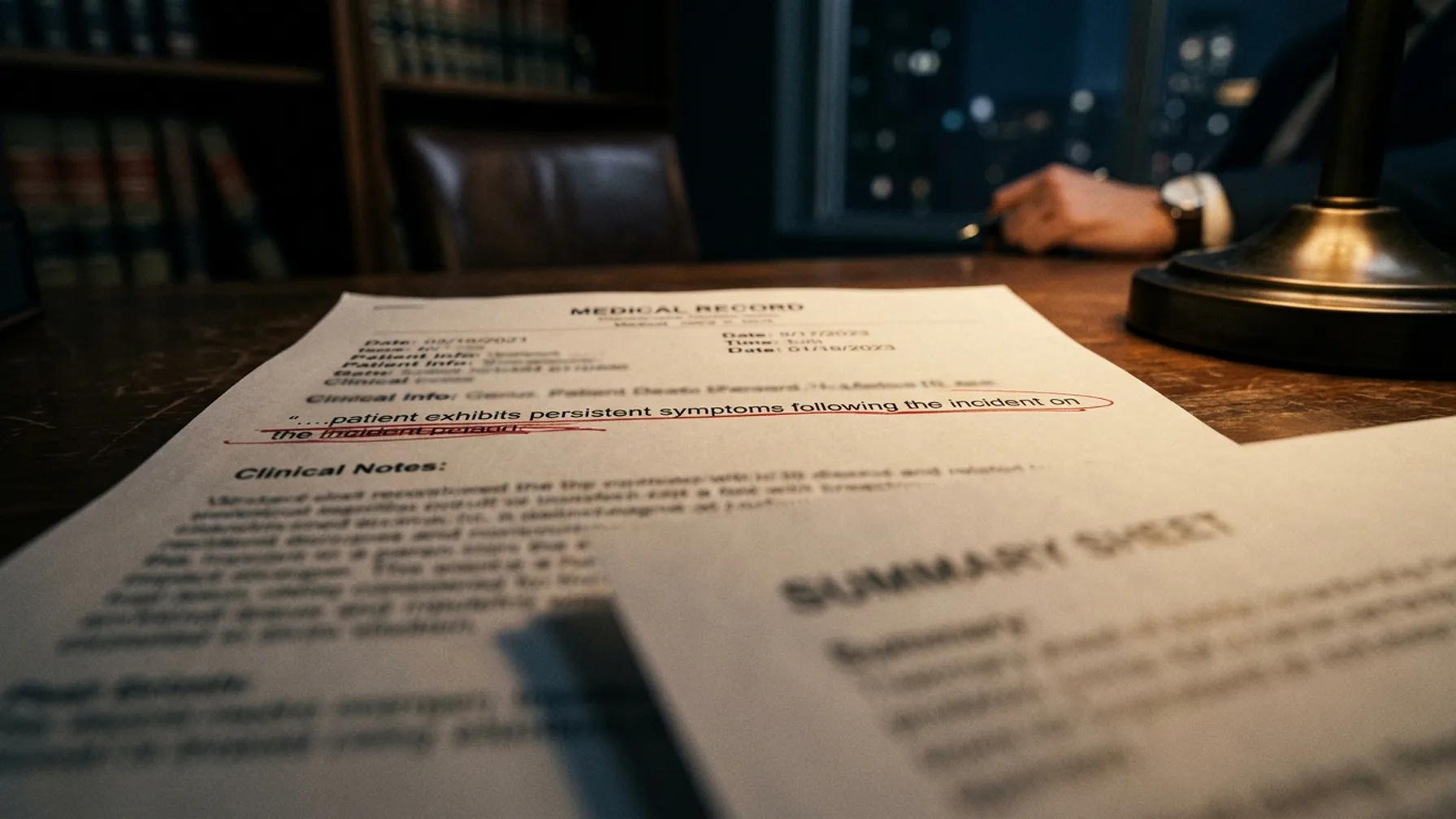
But a link can be real and still mislead. The cited page might mention a condition only as patient-reported history. It might say “possible” or “rule out,” while the chronology presents the condition as confirmed. Or it might describe one physician’s opinion while the summary makes it sound like a finding accepted by all providers.
In each case, the source exists. The problem is what the chronology says the source means.
A useful distinction:
- Traceability: Can you locate the page the chronology points to?
- Support: Does that page actually support the specific statement?
- Context: Does the statement remain accurate when read alongside the rest of the file?
A page-level link supports traceability. The reviewer still needs to assess support and context.
The whole record matters
A citation is a small window into a larger record. The surrounding pages may contain a qualification, correction, or contradiction. A later report may revise an earlier opinion. The chronology may also leave out an important event entirely.
Consider an illustrative example: A chronology says, “The physician released the worker to modified duty,” and cites a progress note. The cited page does mention modified duty. But the next page lists restrictions, and a later report says the worker was taken off work. Reviewing only the linked page may miss the change that matters to the current case assessment.
Dates need the same care. A report date is not always the date of the medical event it describes. A later note may repeat an earlier history without confirming it as a new event. Duplicate or near-duplicate pages can also make a repeated statement look like independent corroboration.
The same applies to causation and apportionment. A chronology should distinguish what each physician said, when they said it, and whether a later opinion changed or clarified an earlier one. A percentage without its qualifications, or without the opinion it supersedes, can give a false impression of certainty.
That does not mean every entry requires rereading every page. It does mean a material claim should be checked against relevant surrounding records, and a change in opinion should be checked against both the earlier and later source.
What a defensible review looks like
A defensible review makes the claim, the source, and the reviewer’s judgment visible. For each material entry, check:
- The exact statement. Break a sentence into individual claims. A single line may include a date, diagnosis, work status, and attribution; each may need separate support.
- The cited page. Confirm the patient, author, document date, and relevant passage. Read enough surrounding context to catch qualifications or negation.
- The wording. Preserve distinctions such as “reported,” “suspected,” “ruled out,” and “confirmed.” Do not turn a patient’s history into a physician’s conclusion.
- The timeline. Compare the event date with the report date. Check whether a later record corrects, repeats, or changes an earlier entry.
- The record set. Compare the chronology with the index and supplied files. Note missing, unreadable, or duplicated material rather than assuming the timeline is complete.
- The decision point. Escalate conflicting or consequential findings for attorney review. The tool can organize evidence; the responsible professional decides what it means for the matter.
When a date, restriction, causation opinion, or apportionment figure is challenged, the reviewer should be able to move from the chronology to the cited passage, inspect the surrounding record, compare relevant earlier and later opinions, and explain what the source does, and does not, establish.
Workplex’s review checklist offers a practical starting point for checking source statements, omissions, and changes in physician findings. Its connected-record guide also recommends assessing an answer in the context of the matter, rather than judging a summary in isolation.

Ask vendors how citations are made
“Every finding is cited” is not enough detail to evaluate a system. Ask how the citation is created and what your team can inspect.
- What exactly does the link identify? Can reviewers open the original page in the supplied record, with a stable page or Bates reference?
- How is the cited passage matched to the claim? Does the system check whether the page supports the statement, or does it attach a nearby page based on document location or topic?
- Can reviewers see surrounding context? Check whether adjacent pages and relevant records are accessible without losing the place in the chronology.
- How does the system handle qualifications? Test negation, uncertainty, patient-reported history, and conflicting opinions.
- How are amendments and later opinions handled? Ask whether earlier and later findings are shown together, with the change clearly identified and both sources available.
- What happens when a page is unreadable or the source is unclear? A responsible workflow should make uncertainty visible rather than silently filling in the gap.
- How can your firm test performance? Ask to assess representative files, including long records, scans, handwritten notes, duplicate pages, and conflicting reports. Review not only time saved, but also unsupported claims, missed events, and correction effort.
These are testable questions. Agree on the record set, review criteria, and stop conditions before a pilot begins. Then have the people who prepare and approve the work inspect the results. Measure the whole task: intake, source checking, corrections, and final approval, not just the time it takes to produce a first draft.
Citations do not replace attorney review
Source links can improve the review process, but they do not make a medical chronology admissible or establish that its contents are true. Whether a document or summary may be used in a proceeding depends on its purpose, applicable rules, foundation, and the circumstances. A linked AI output should not be treated as a substitute for the underlying records or a qualified witness.
Lawyers remain responsible for reviewing and approving work product. The ABA’s Formal Opinion 512 discusses lawyers’ professional obligations when using generative AI, including competence and checking the accuracy of output.
A medical chronology is most useful when it helps the team find and assess evidence, not when it asks the team to trust a polished summary. Page-level citations are an important part of that process. The standard should go further: verify that each material claim is supported, look for qualifications and later changes, and keep the full record available for review.
For firms considering medical records legal AI, start with a focused evaluation and your own files. Define what a correct, reviewable chronology must show, then test whether the system helps your team meet that standard. The final judgment stays with your people.